

The Hidden Cost of Doing the Same Admin Twice
Copying information between systems, sending the same emails and updating spreadsheets might only take a few minutes. Across a business, those minutes quickly add up.
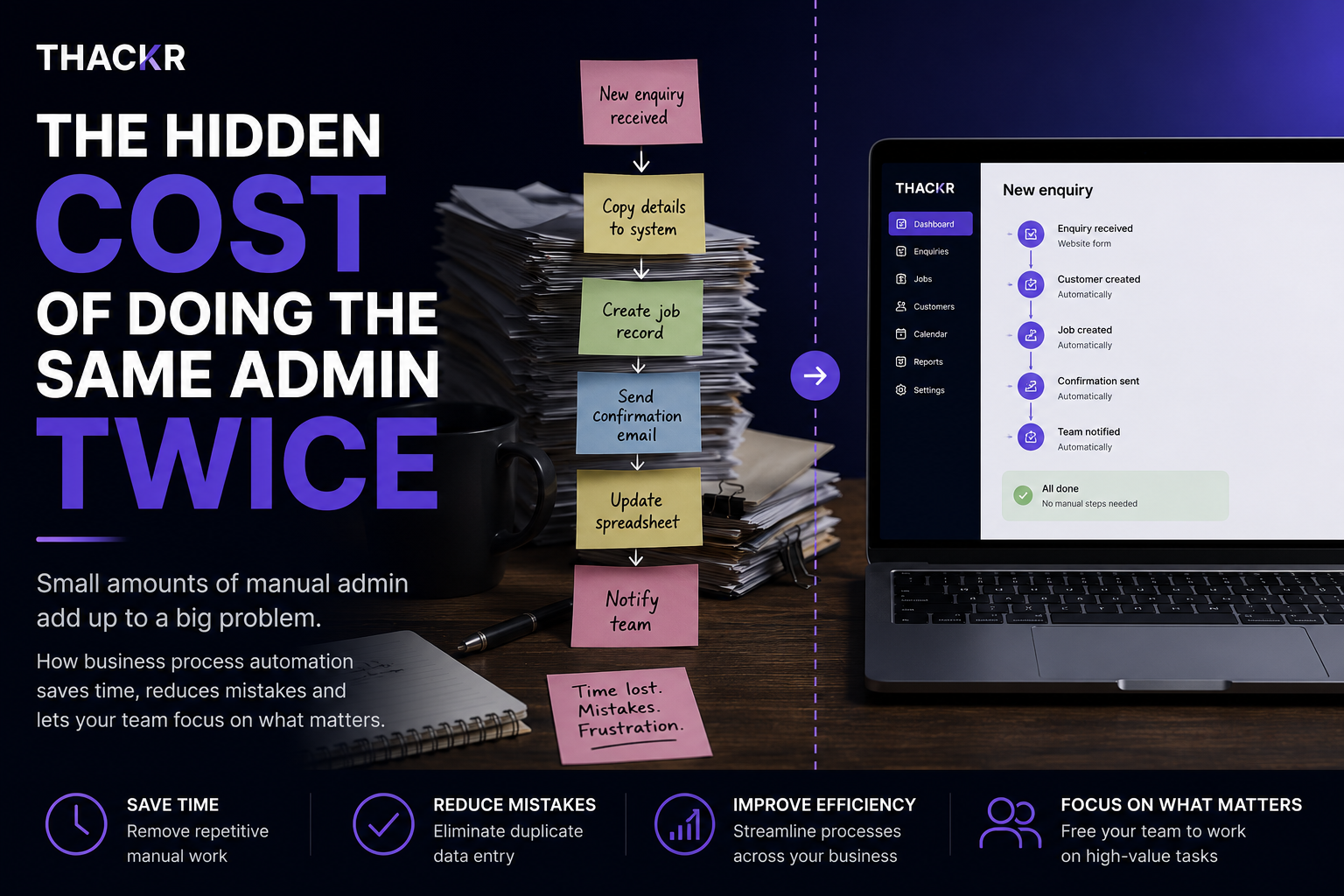
Most businesses have repetitive admin.
A customer fills in a form. Someone receives it by email and copies the details into another system.
A job is completed. Someone updates the job and then updates a spreadsheet containing much of the same information.
An order comes in. Someone creates the customer, creates the order, sends a confirmation email and tells another member of the team that something needs doing.
None of these tasks feels particularly expensive.
Some might only take a couple of minutes.
The problem appears when you multiply those few minutes by every customer, every job and every working day.
At that point, small pieces of unnecessary admin can become a surprisingly large part of someone’s job.
Manual admin is not always a problem
There is nothing inherently wrong with doing something manually.
If a task happens twice a month and takes five minutes, spending thousands of pounds automating it probably makes no sense.
Manual processes can also be a good way to get something working quickly.
A new business might start by receiving enquiries through email and manually entering them into a spreadsheet. That’s simple, cheap and perfectly adequate when there are only a handful of enquiries.
Problems tend to appear as the volume increases.
Five enquiries become fifty.
One employee becomes five.
The spreadsheet becomes several systems.
Before long, a process that originally made sense has become part of the business simply because nobody has stopped to question it.
Five minutes doesn’t sound like much
Imagine a member of staff has a repetitive task that takes five minutes.
They do it 20 times each day.
That’s 100 minutes a day spent on one piece of admin.
Across a five day week, that’s more than eight hours.
An entire working day.
Now imagine there are several similar processes happening across the business.
This is why looking at individual tasks can be misleading. Saving three or four minutes doesn’t sound particularly exciting.
Saving hundreds of those minutes every month is very different.
Look at how information moves through your business
One of the easiest ways to find unnecessary admin is to follow a piece of information through the business.
Take a new customer enquiry.
They might fill in a form on your website containing their:
Name
Address
Email address
Telephone number
Service required
Preferred date
The business already has the information.
What happens next?
If someone receives an email and manually copies those details into another system, the business has created work without creating any new information.
Perhaps that employee then creates a job.
They send the customer a confirmation email.
They update a spreadsheet.
They notify another department.
They might even copy some of the same information into another piece of software.
The customer provided their details once, but the business has handled the same information several times.
That’s where business process automation can make a real difference.
What could the same process look like?
The customer submits the enquiry.
Their customer record is created automatically.
The job is created using the information they provided.
The appropriate workflow starts.
A confirmation is sent.
The relevant member of staff can immediately see what needs doing.
Nobody has had to copy an address from an email.
Nobody has had to remember to send the confirmation.
Nobody has had to add another row to a spreadsheet.
The work itself still needs doing.
The unnecessary steps around it don’t.
Automation should not mean removing people
Business automation is sometimes presented as a way of replacing employees.
I don’t think that’s the most useful way to look at it.
A member of staff manually copying a customer’s telephone number from one system into another isn’t providing some unique human value to the business.
They’re just moving data.
The same person could be speaking to customers, solving problems, managing exceptions or doing something else that actually requires their judgement.
Good automation removes the repetitive steps around people’s jobs.
It doesn’t have to remove the people.
Repeated data entry also creates mistakes
Time isn’t the only cost of manual admin.
Every time information is retyped, there is another opportunity for something to go wrong.
A telephone number gets entered incorrectly.
Part of an address is missed.
Someone selects the wrong customer.
A spreadsheet isn’t updated.
An email isn’t sent.
The mistake might take seconds to make and considerably longer to find.
Sometimes it isn’t discovered until a customer calls because something hasn’t happened.
Reducing unnecessary data entry can therefore do more than save time. It can also improve the consistency of the process.
Your systems shouldn’t create more admin
Another warning sign is software that doesn’t communicate with anything else.
A business might have separate systems for:
Customer enquiries
Job management
Accounting
Stock
Customer communication
Reporting
Having several systems isn’t necessarily a problem.
The problem is when employees become the connection between them.
If your integration between System A and System B is a person copying information across every afternoon, you don’t really have an integration.
You have another manual process.
Sometimes existing software can be connected.
Sometimes a simple automation is enough.
In other situations, bespoke software might make more sense.
The answer depends on the business and the process.
Where should you look for opportunities to automate?
Start with the boring stuff.
Look for things your team does repeatedly.
Ask questions such as:
What information do we regularly enter more than once?
If customer, job or product information is being copied between different places, find out why.
What emails do we send repeatedly?
Confirmations, reminders and routine updates are often good candidates for automation.
What spreadsheets do people manually update from another system?
If the information already exists digitally, there may be no reason for someone to keep copying it.
What reports are created manually every week?
If somebody spends Friday afternoon gathering the same numbers from the same places, the process may be able to produce the report automatically.
What tasks rely on somebody remembering to do something?
A good system can trigger the next step based on what has already happened.
These are usually more useful questions than simply asking, “What can we automate?”
Don’t automate a bad process
There is an important catch.
Automation doesn’t automatically make a process good.
If a process has unnecessary steps, automating every one of those steps can simply create a faster bad process.
Before building anything, understand why each step exists.
You may find that some of them don’t need automating at all.
They can just be removed.
The best solution is sometimes surprisingly small.
Start with the repetitive work
You don’t need to transform an entire business at once.
Pick one process.
Follow it from beginning to end.
Look at where information comes from, who touches it, where it goes and how many times the same information gets handled.
Then ask a simple question.
Does a person actually need to do this part?
Sometimes the answer will be yes.
A decision needs making. A customer needs speaking to. Something unusual has happened.
Keep the human involved.
But if the job is simply taking information that already exists and putting it somewhere else, there’s a good chance software can handle it.
Final thoughts
Small amounts of admin are easy to ignore.
Two minutes here and five minutes there don’t look like a serious business problem.
At scale, they can be.
The biggest opportunities for business process automation are often not complicated or particularly exciting.
They’re the repetitive jobs people have been doing for so long that nobody questions them anymore.
If someone in your business regularly takes information from one place and puts it somewhere else, start there.
You might find you’re paying for far more admin than you realised.
Spending too much time on repetitive admin?
At Thackr, I build software and automation around the way businesses actually work.
That might mean connecting existing systems, automating part of a workflow or building a bespoke system where the current tools no longer fit.
The aim isn’t to automate everything.
It’s to remove the unnecessary work so your team can spend their time on the things that actually need them.
Related insights

The AI Agent That Assumes: Why Automation Needs to Ask, Not Guess
AI agents are good at filling in gaps quietly, which is exactly the problem. Here's why business automation needs to be built to ask rather than assume, with real examples.

You Inherited a System Nobody Can Explain. Now What?
When you inherit software with no documentation and no developer to ask, the temptation is to rewrite it fast. Here's a safer way to work out what it actually does first.

Your AI Coding Assistant Doesn't Remember Last Week's Decisions
AI coding agents don't carry memory of past decisions between sessions the way a human developer does. That gap shows up as inconsistency in your codebase, and it matters more than most people realise.